After completing her performance in San Francisco on January 22, 1938, Choi Seung-hee departed for Los Angeles on the morning of January 24. The Japanese edition of the Shinsekai Asahi Shimbun (Page 3) dated January 25, 1938, reported as follows:
“Choi Seung-hee, the beauty from the Korea, and her entourage, who achieved outstanding success at a performance held here last Saturday night, departed at 8:00 a.m. yesterday morning for Los Angeles. Upon departure, she asked this newspaper to convey their deep gratitude for the kindness they received from all over the region during their stay in San Francisco.”
Choi Seung-hee and her party departed San Francisco at 8:15 a.m. aboard the Southern Pacific Railroad’s “Daylight” train. Although San Francisco Station is now located at King and 4th Street, in 1938 it was situated at Townsend and 3rd Street, and this station served as the terminus for three railroad companies: Southern Pacific, Central Pacific, and Western Pacific.

The Daylight was a train connecting San Francisco Station and Los Angeles Central Station along the Southern Pacific Railroad’s Coast Line, and it began service in April 1922 as the Daylight Limited. Originally operating only on weekends, the service was expanded to daily service in April 1923. By 1927, it covered 760 kilometers (470 miles) nonstop in 12 hours, earning the title of “the fastest train in the West.”
As the route abandoned its non-stop policy and began stopping at five intermediate stations in 1928, the train’s name was shortened from the “Daylight Limited” to “Daylight.” On March 21, 1937, the train was streamlined, reducing the travel time to 9 hours and 45 minutes. The Daylight, which still runs along California’s Pacific coastline today, is promoted as the "most beautiful passenger train in the world.”

As of January 1938, the one-way fare for coach class on the Daylight—which Choi Seung-hee and her party boarded—was $9.47, while the one-way fare for first class was $14.20 (+$1.50 seat charge). The first-class fare is equivalent to $215 today (based on consumer price index), or approximately 330,000 Korean won. Since the U.S. statutory minimum wage at the time was $1 per hour, the first-class fare was roughly equivalent to two days’ wages for an American worker.

On Monday, January 24, 1938, the Daylight, carrying Choi Seung-hee and her party, departed San Francisco at 8:15 a.m., arriving in San Jose at 9:10 a.m., Salinas at 10:32 a.m., San Luis Obispo at 1:07 p.m., Santa Barbara at 3:35 p.m., and 5:38 p.m. in Glendale, arriving at Los Angeles Central Station at 6:00 p.m. sharp. The English edition of the Shinsekai Asahi Shimbun (Page 1) reported on this as follows on January 27, 1938.
“LOS ANGELES, Jan. 26 Sai Shoki, the Korean dancer who made her American debut in San Francisco, dazzled Los Angeles with her beauty upon her arrival here Monday evening. ... Accompanied by her manager-husband, Hitsusho An, and Koshun Lee, pianist, the dancer attracted a good-sized crowd as she stepped off the ramp of the train from San Francisco. Her gracefulness and beauty eclipsed the presence of some Koreans wearing badges, "Don't Buy Japanese Goods.”
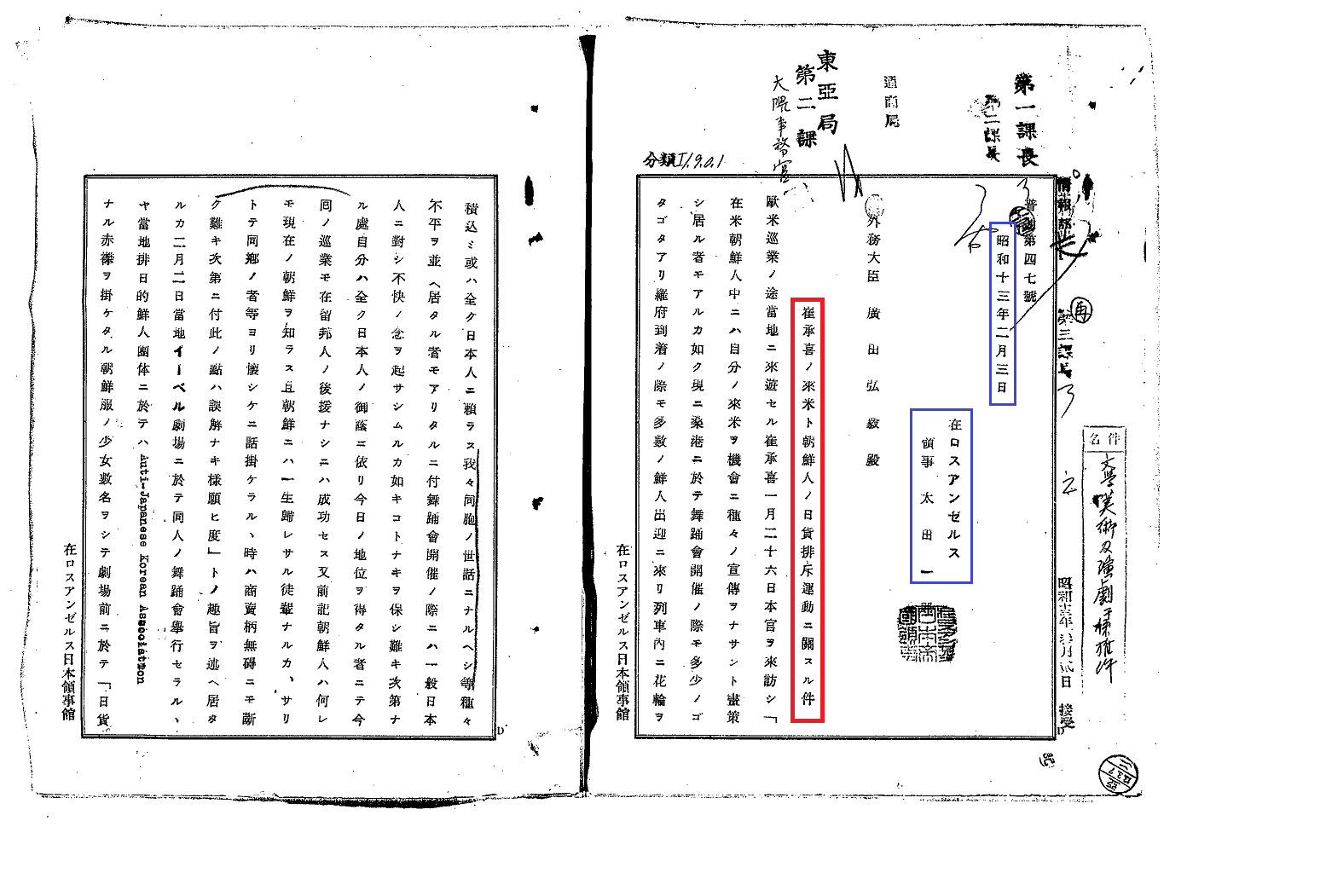
The situation upon Choi Seung-hee’s arrival in Los Angeles was also described in a report sent by Ichiro Ota (1902–1996), the consul at the Japanese Consulate in Los Angeles, to Japanese Foreign Minister Koki Hirota (1878–1948).
“Upon her arrival in LA, many Koreans came to greet her. Some presented her with wreaths on the train, while others voiced various complaints, such as telling her not to rely on the Japanese but to accept help from our fellow Koreans, and so on... ”
Korean compatriots, Japanese fans, and the Japanese diplomatic mission in LA all welcomed Choi Seung-hee, but their expectations were all different. The Japanese diplomatic mission wanted Choi Seung-hee, as a Japanese artist, to help ease anti-Japanese sentiment among the American people, but the Korean compatriots hoped that Choi Seung-hee, as a Korean dancer, would sever ties with the Japanese and participate in the “boycott of Japanese goods” movement. Choi Seung-hee, who wanted to introduce Korean art to the world, found herself in a dilemma: she needed the cooperation of the Japanese consulate, but she could not be treated as a Japanese artist.
Just as in San Francisco, Choi Seung-hee faced difficulties in Los Angeles due to the discord between Korean compatriots and Japanese fans, as well as the difference in stance between the Japanese consulate and herself. (jc, March 29, 2026) ⓒ CHO Jeong-hee
'최승희100장면' 카테고리의 다른 글
| [崔承喜100シーン] 5. ニューヨーク (0) | 2026.03.31 |
|---|---|
| [최승희 100장면] 5. 뉴욕 (0) | 2026.03.31 |
| [崔承喜100シーン] 4. ロサンゼルス (0) | 2026.03.31 |
| [최승희 100장면] 4. 로스앤젤레스 (1) | 2026.03.31 |
| [Choi Seung-hee 100 Scenes] 3. San Francisco (0) | 2026.03.28 |


