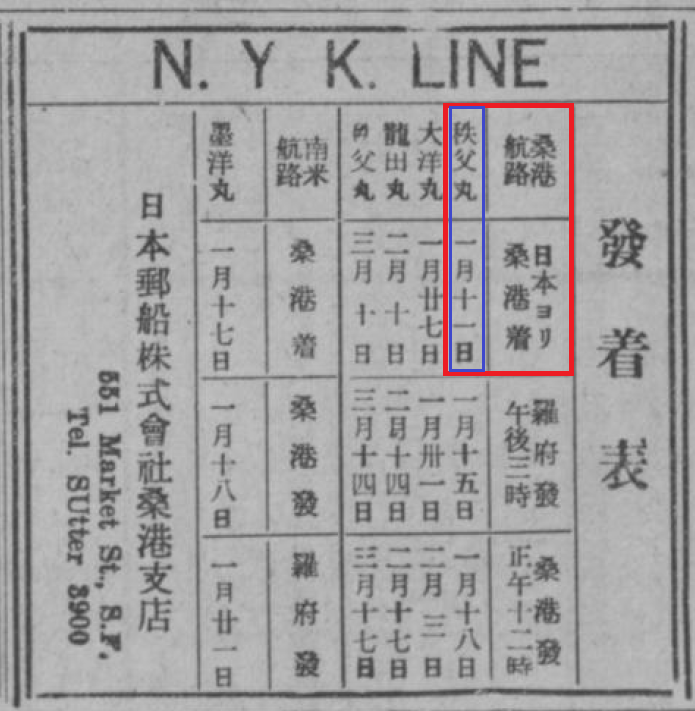
Choi Seung-hee departed Yokohama on December 29, 1937, and arrived in San Francisco on January 11, 1938, after a voyage of about two weeks. She was accompanied by her husband and manager, Ahn Mak, and her pianist, Lee Gwang-jun. San Francisco was the first stop on her world tour scheduled to last three years, and her performance there was set for January 22.
When the passengers of the M.S. Chichibu Maru disembarked, U.S. Immigration compiled a passenger manifest. This list likely served as documentation for immigration screening, customs inspection, and health quarantine. On page 8 of the Chichibu Maru passenger manifest discovered in the U.S. Immigration Archives, the names of Choi Seung-hee and Ahn Mak were listed. This constitutes tangible evidence that Choi Seung-hee arrived in San Francisco.
On this list, Ahn Mak’s name is listed as An Hitsusho and Choi Seung-hee’s as Sai Shoki; these are Japanese-style pronunciations of their Chinese characters—Ahn Mak’s real name, An Pil-seung (安弼承), and Choi Seung-hee’s (崔承喜). Their passports likely contained these English names as well.

This official document provided a wealth of information. It revealed that (1) the ship was the “M.S. Chichibumaru,” which departed from Yokohama, Japan, on November 29, 1937; (2) Choi Seung-hee was 25 years old and Ahn Mak was 27 as of their disembarkation date; and (3) their occupations were professional ballerina and her manager.
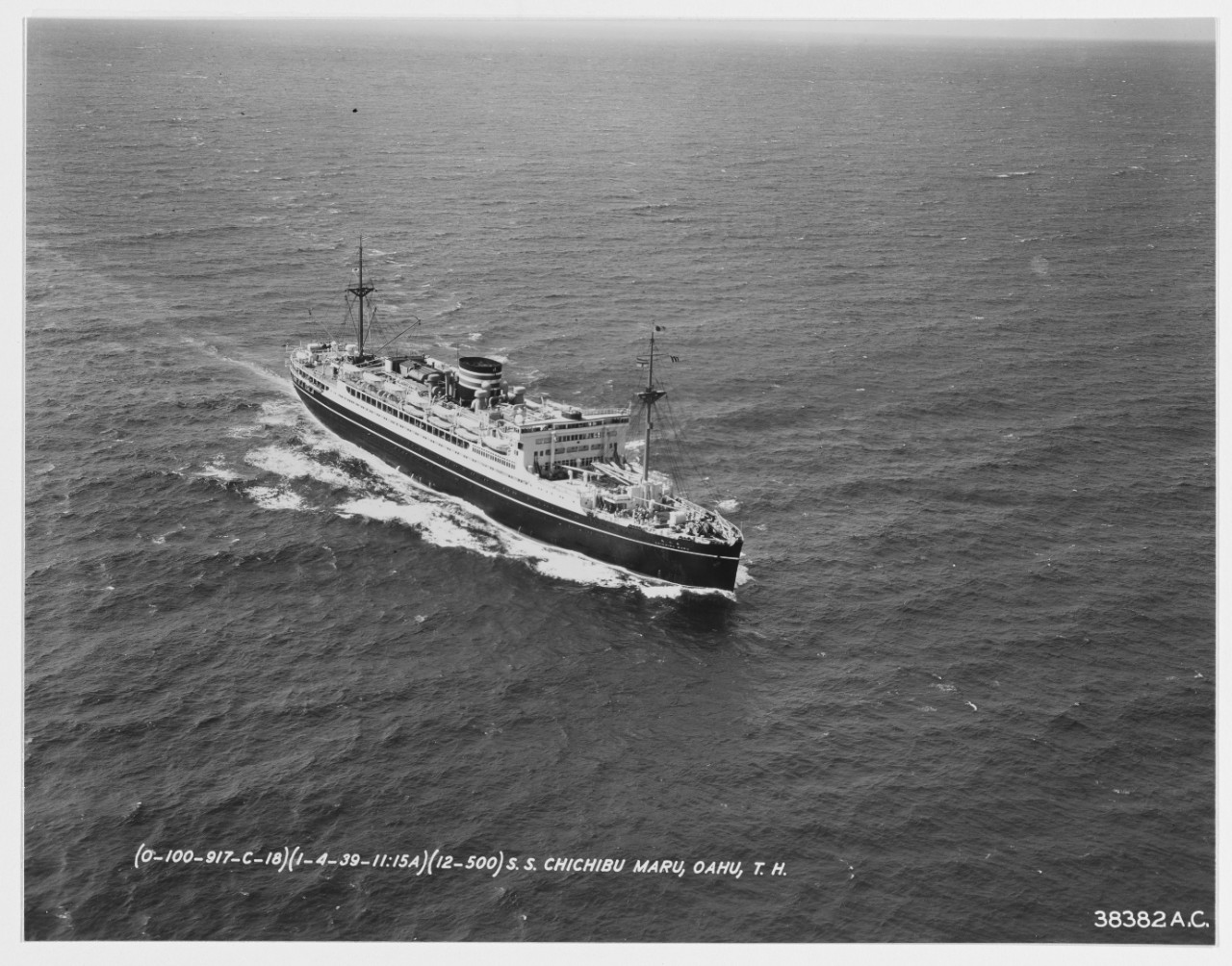
The “M.S.” preceding the ship’s name stands for “Motor Ship.” It is an abbreviation placed before the names of vessels equipped with diesel engines. The Chichibu Maru was a passenger ship launched on May 8, 1929. Equipped with four diesel engines, with a total length of 178 meters, a displacement of 22,560 tons, and a capacity of 1,159 people (836 passengers and 323 crew members), it was Japan’s largest passenger ship at the time of its launch.
The Chichibu Maru’s English name was changed to Titibu Maru in 1938, but due to criticism that it evoked the slang term “tit” (referring to a woman’s breast), it was renamed Kamakura Maru(鎌倉丸) in 1939. During the Pacific War in 1942, it was requisitioned by the Japanese Navy and used as a military hospital ship and transport vessel, but it was sunk on April 28, 1943, off the coast of the Philippines by a torpedo attack from a U.S. Navy submarine (USS Gudgeon).
The passenger manifest, typed to conform to U.S. Immigration Service forms, contained entries that had been amended during the immigration inspection. (4) Choi Seung-hee’s occupation was changed from “Dancer” to “Professional Dancer,” and (5) the “race or ethnicity” of Ahn Mak and Choi Seung-hee was changed from “Japanese” to “Korean.” These corrections appear to have been made in pencil by an immigration official at the request of Choi Seung-hee and Ahn Mak.
The change from “dancer” to “professional dancer” appears to have been made to clearly distinguish her as an artistic dancer rather than an entertainer. Although the two, who had to travel on Japanese passports, could not deny their Japanese nationality, they insisted on clarifying that their race was “Korean” rather than “Japanese” and had the entry amended accordingly.
The controversy over whether she was “Korean or Japanese” was a constant source of friction between Choi Seung-hee and Japanese diplomatic authorities during their tour of the United States and Europe, and the seeds of this conflict were already evident in the passenger manifest of the Chichibu Maru.

The English edition (Page 7) of the Japanese-American newspaper “Shinsekai Asahi Shimbun(新世界朝日新聞)” (January 13, 1938), published in San Francisco, ran an article with an very unusual headline and lead “Sai Shoki is truly beautiful,” and added that “Such was the unanimous impression of all the ship reporters and cameramen who went to greet her when the Chichibu Maru arrived here Tuesday afternoon."
The article reported that Choi Seung-hee was "wearing her simple and exotic Korean costume” when she disembarked, and quoted Choi Seung-hee as saying, “I am looking forward to the debut I am making in San Francisco on January 22, for if I am a success here, I am sure that I shall be successful on my present trip around the world.”

Another Japanese-American newspaper, "The Nichibei Shimbun(日米新聞)" (January 11, 1938), also reported similar content in its English edition (Page 4), but the editing and printing quality of this newspaper were poor. The second line of the article was printed upside down, making it difficult to read, and there were two typographical errors in a sentence. The word “arrival” in the second line should be corrected to “arrive,” and “abroad” in the third line should be corrected to “aboard” to make the meaning clear and conform to English grammar.
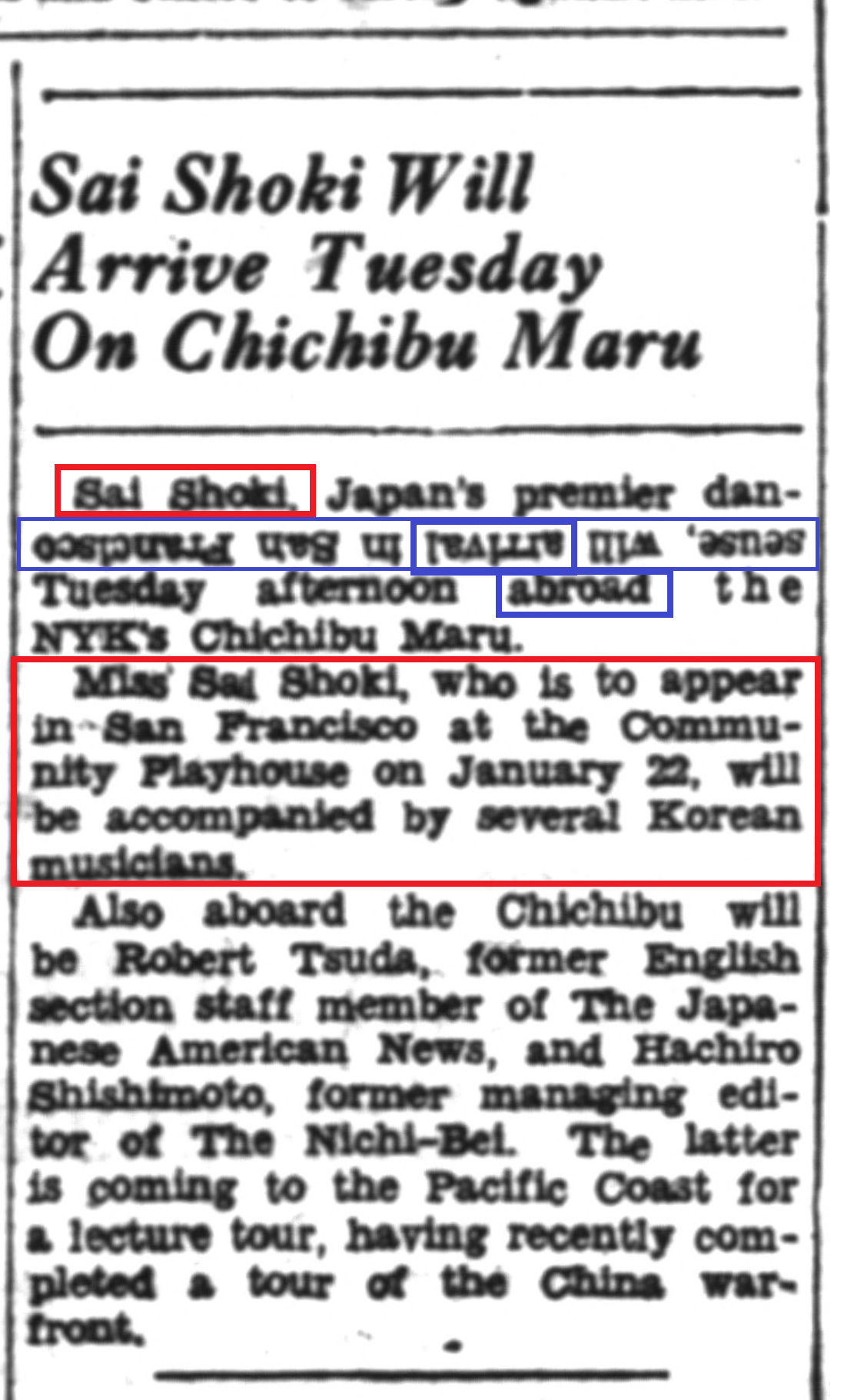
Furthermore, while the article speculated that Choi Seung-hee would perform accompanied by “several Korean musicians," the only accompanist was pianist Lee Gwang-jun, and her husband, Ahn Mak, who acted as her manager, occasionally kept the beat on a drum or janggu. (jc, 11/18/2025; 3/27/2026) ⓒCho Jeong-hee
'최승희100장면' 카테고리의 다른 글
| [崔承喜100シーン] 4. ロサンゼルス (0) | 2026.03.31 |
|---|---|
| [최승희 100장면] 4. 로스앤젤레스 (1) | 2026.03.31 |
| [崔承喜100シーン] 3. サンフランシスコ (0) | 2026.03.28 |
| [최승희100장면] 3. 샌프란시스코 (0) | 2026.03.28 |
| [Choi Seung-hee 100 Scenes] 2. Honolulu (0) | 2026.03.27 |


