On December 29, 1937, Choi Seung-hee boarded the Chichibu Maru, a mail ship operating on the trans-Pacific route, and departed from Yokohama bound for San Francisco. This marked the first leg of her world tour that would continue for the next three years.
After setting sail from Yokohama, Choi Seung-hee and her entourage arrived in Honolulu, Hawaii, on January 5, 1938, following a voyage of about one week. The Chichibu Maru remained in port overnight to unload cargo and mail and to allow passengers to board and disembark. The ship was scheduled to depart for San Francisco the following morning.
While the Chichibu Maru was docked in Honolulu, Choi Seung-hee held a joint press conference with local journalists, and even visited some media outlets in person. This photograph was taken by the Japanese-American daily newspaper <The Nippu Jiji(日布時事)>.
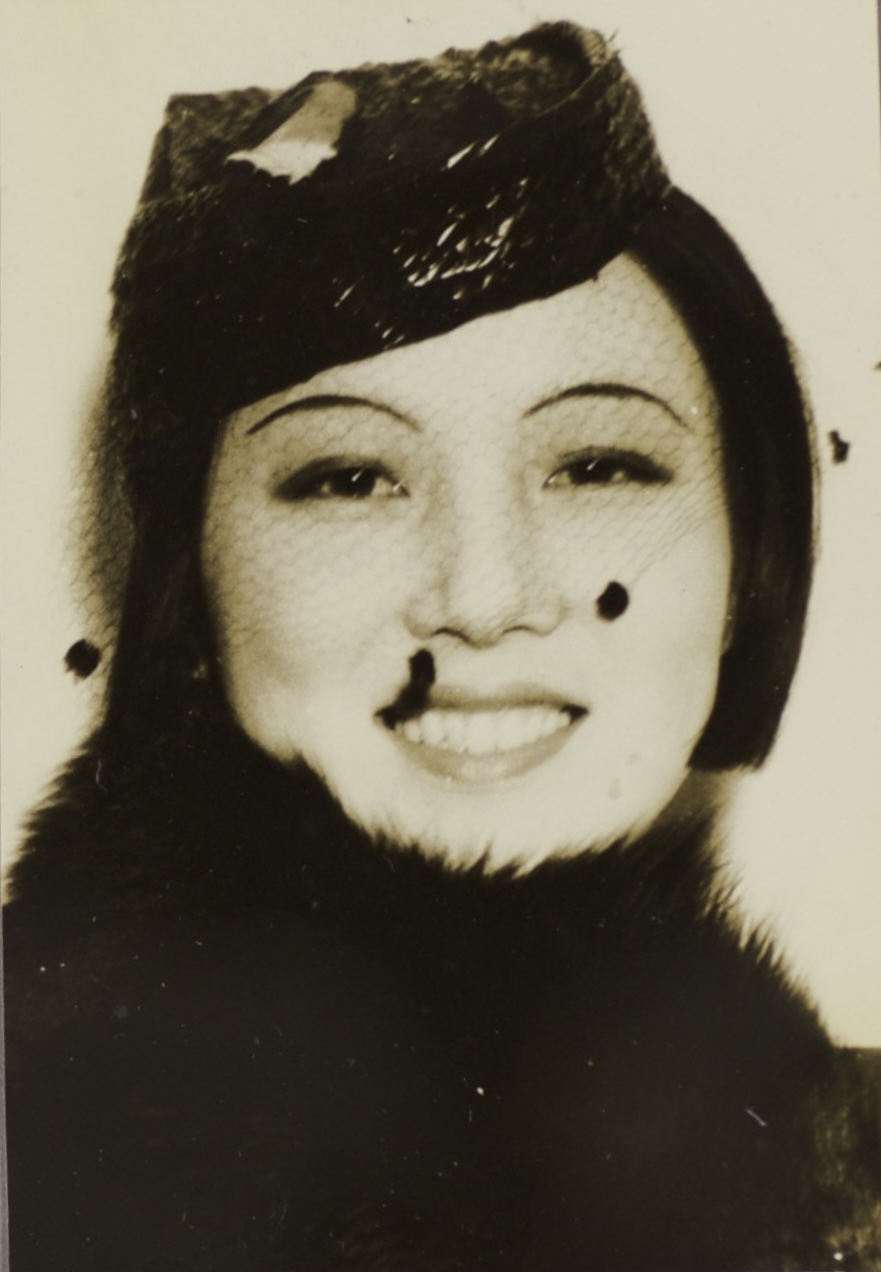
<The Nippu Jiji> was a newspaper that had a contract with Japan’s <Jiji Shinpo(時事新報)> to provide articles from the United States in exchange for receiving news from the mainland Japan. Founded in Hawaii in 1895 as the <Yamato Shimbun(やまと新聞)> and renamed <The Nippu Jiji> in 1905, the newspaper became a bilingual publication in 1919, reporting news and advertisements in both Japanese and English. Its English-language title was <The Hawaii Times>.
Along with the Tokyo Station photograph of Choi Seung-hee, this one was also held in the archives of the <The Nippu Jiji>’s Research Department before being transferred to the archives of Stanford University’s Hoover Library. The Hoover Library assigned the identification code J2297.004 to this photograph, meaning it is the fourth photograph in the 2,297th collection related to Japan (J).
Although Korea was liberated from Japanese colonial rule in August 1945, materials related to Choi Seung-hee in American libraries were still classified as Japanese materials. However, the Hoover Library recorded Choi Seung-hee’s name by listing both the Japanese name “Shoki Sai” and the Korean pronunciation “Choi Seung-hee” side by side, thereby indicating that she was Korean.
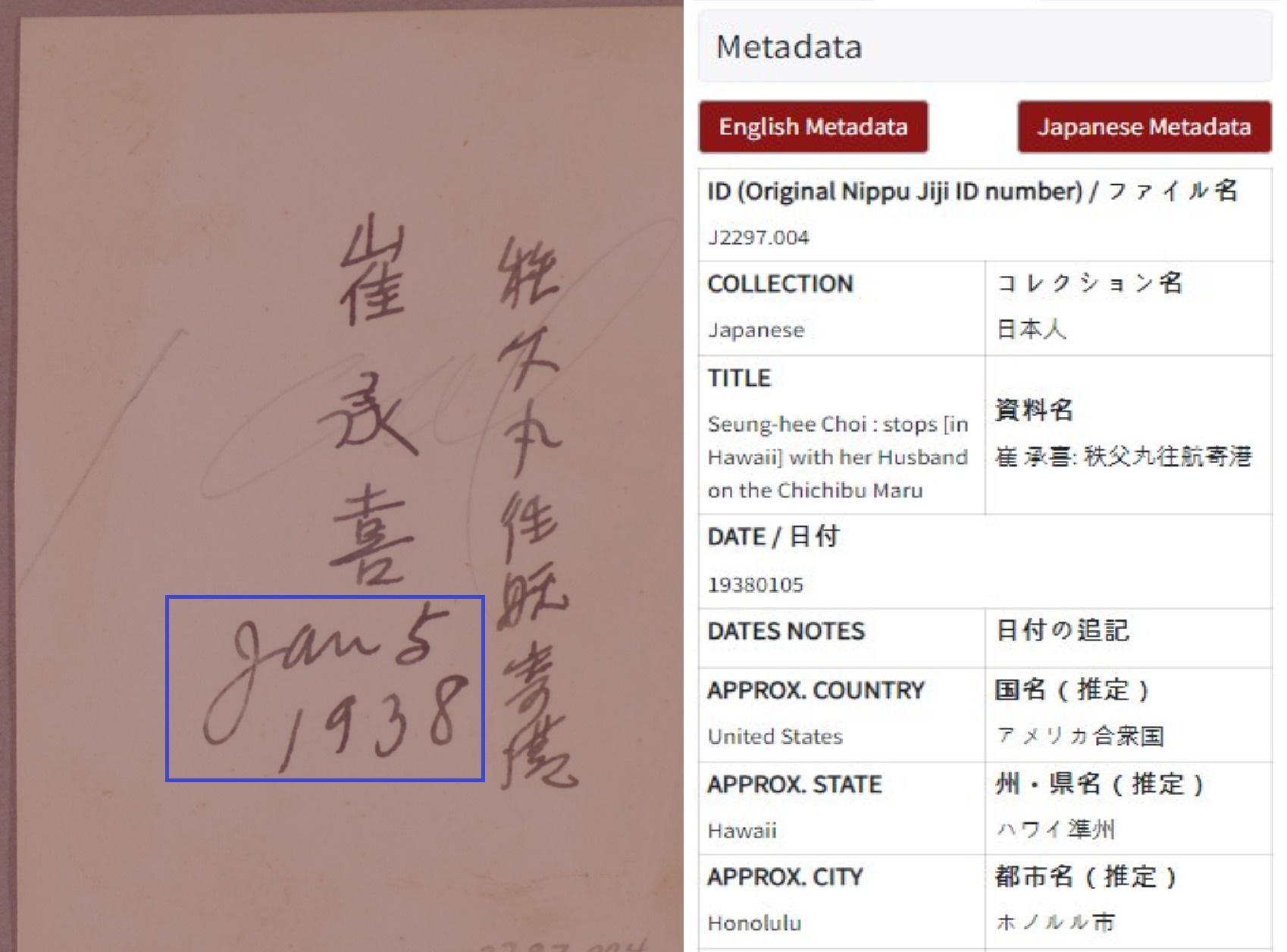
The <The Nippu Jiji> titled this photograph “Choi Seung-hee: Chichibu Maru Outbound Voyage Stopover,” meaning it was taken during a stopover in Hawaii while on a voyage from Japan to the United States. If it had been a voyage from the United States to Japan, it would have been called an “inbound voyage.”
This is similar to the Japanese practice of dividing train directions into “upbound” and “downbound” lines. It was customary in Japan to call trains traveling from the provinces to the capital “upbound,” and those traveling from the capital to the provinces “downbound.” Therefore, during the Japanese colonial period, a train traveling from Seoul to Busan was considered “upbound” because it was heading toward Tokyo.
After liberation, the Korean term for a train departing from Seoul for Busan was changed to “downbound,” but the hierarchical naming convention of “upbound” and “downbound” remained in place. This contrasts with practices in Europe and the Americas, where phrases like “Seoul to Busan” or “Busan to Seoul” are used, implying no hierarchy between the capital and the provinces.
Japan had a similar convention for shipping routes. In Japanese practice, voyages moving away from the homeland were called “oko” (往航), while those returning to the homeland were called “raiko” (來航), or “kiko” (帰航) and “fukuko” (復航). I haven’t verified whether this convention is still in use in Japan today, but at least that is how it is defined in Japanese dictionaries.
This photograph was dated January 5, 1938, and the location was identified as “Honolulu, Hawaii Territory, United States of America.” Although the English name for Hawaii was “Hawaii Territory,” it was translated as “Hawaii Lingtu(領土)” in Chinese and “Hawaii Juneshu(準州, じゅんしゅう)” in Japanese. This is because, as of January 1938, Hawaii had not yet been admitted as a U.S. state.
After overthrowing the Kingdom of Hawaii in January 1893, the United States established the Republic of Hawaii. In August 1898, the Republic of Hawaii was annexed by the United States, and on April 30, 1900, it was designated a U.S. territory. Following a referendum in June 1959, Hawaii became the 50th state of the United States by a resolution of the U.S. Congress on August 21 of that year. Therefore, in 1938, when Choi Seung-hee passed through Hawaii, it was still a “territory(準州).”
This photograph has four ink stains on it. Two of the stains are on Choi Seung-hee’s face. While these could easily be retouched with Photoshop today, it seems that correcting them was not easy at the time. In the same photograph published in an article reporting on Choi Seung-hee’s trip to the United States in the English edition of the <The Nippu Jiji> (Page 2) dated January 6, 1938, the blemishes on her face can be seen printed exactly as they were.

According to this article, Choi Seung-hee was traveling with her husband, who also served as her manager, and a pianist accompanist, and was visiting the United States and Europe for the purposes of “performance and research.” The article also identified the agency organizing Choi Seung-hee’s U.S. tour as the “Metropolitan Musical Bureau.”
The article also noted that Choi Seung-hee was born in Gyeongseong (=Seoul) and reported that she had been living and performing in Tokyo for the past 12–13 years. This is a simple calculation based on the period from 1926, when Choi Seung-hee began her dance career, to 1938, when she started her world tour. Since this period includes her three years of activity in Gyeongseong (1929–1933), her actual period of activity in Tokyo (1926–1929, 1933–1938) was just over eight years. The article also added that Choi Seung-hee’s trip to the United States was her first overseas journey departing Korea and Japan.

In addition to this photograph, the <The Nippu Jiji> took and printed one more photo of Choi Seung-hee; on the back of this photo, the note “Dancer Choi Seung-hee” is accompanied by the date “January 5, 1938,” written twice in handwriting and stamped twice. The handwritten date shows signs of having been written as “1937” and then corrected to “1938”; this was likely a mistake caused by habitually using the previous year’s date at the beginning of the new year.
The Hoover Library classified this photograph as the third image in the same collection as the fourth photograph. This photograph also shows two smudges on Choi Seung-hee’s face. The stains are on her left cheek and lip. It is difficult to speculate why this error occurred, but it appears to be a mistake made during printing or development.
This photograph was published alongside a Japanese-language article in the Japanese edition of <The Nippu Jiji> (page 6). The article also noted that Choi Seung-hee’s interview was conducted in front of a group of reporters and explicitly mentioned the names of her accompanying husband (Ahn Pil-seung) and pianist (Lee Gwang-jun). The article further reported that Choi Seung-hee expressed regret that she could not perform in Honolulu because she was scheduled to depart the following morning, and instead would deliver a greeting to Japanese and Korean people via a radio broadcast early on the morning of her departure.
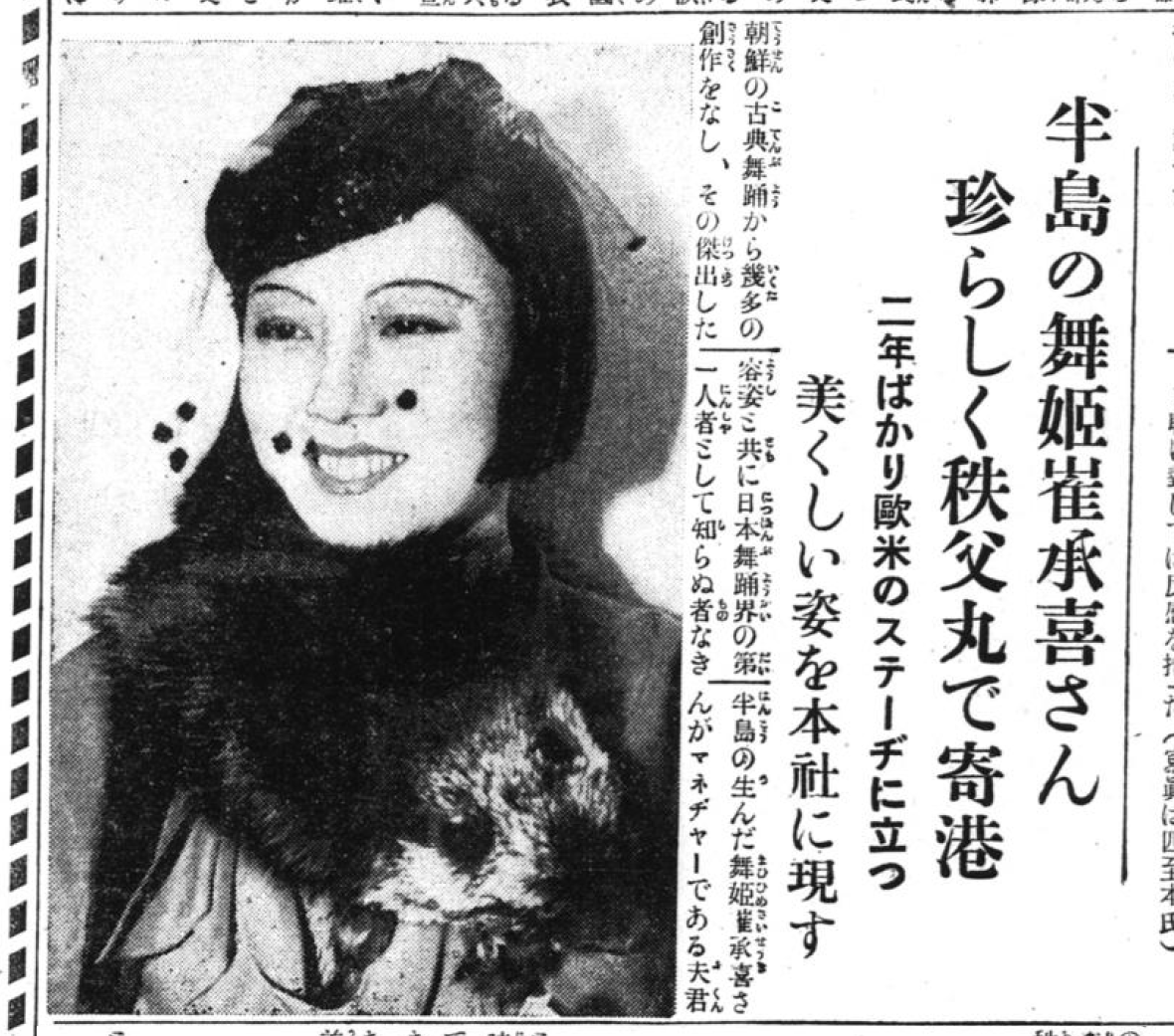
Choi Seung-hee visited the offices of another Japanese expatriate newspaper in Honolulu, <The Hawaii Hochi> (布哇報知). An interview article featuring a photograph of Choi Seung-hee appeared on page 3 of the January 6 issue of this newspaper; the accompanying photograph also showed five spots around her face.
The content of the article was largely similar to that of <The Nippu Jiji>, but it noted that Choi Seung-hee visited the <The Hawaii Hochi> office, saying “through the arrangements of Mr. Ed Purkis, she would make her debut on January 20 via the New York Metropolitan Musical Bureau, tour various parts of the United States over the course of two months to introduce traditional Korean dance, and subsequently travel to Europe to perform on stages for about two years while studying local dance styles before returning.”
The article went on to quote Choi Seung-hee as saying, “Japan is currently in a state of emergency, and the entertainment industry has been severely impacted, but Tokyo is gradually returning to stability.” Finally, it reported that she said, “I hope to come to Hawaii someday to perform for you all,” and left a message saying, “I hope you will support me then.”
The “state of emergency” Choi Seung-hee referred to was the wartime situation resulting from the Sino-Japanese War, which began when Japan invaded the Chinese mainland on July 7, 1937; she conveyed that the entertainment industry was also suffering greatly as a result.
The remark that “Tokyo is gradually regaining stability” appears to reflect the situation at the time when the Japanese military had seized the initiative in the Sino-Japanese War by occupying Nanjing.
However, she did not mention that anti-Japanese sentiment among Americans was intensifying as news of the Nanjing Massacre reached the United States, nor did she mention that her performance in the U.S. was being held at the government’s recommendation to help ease American anti-Japanese sentiment. (jc, 11/27/2025; 3/27/2026) ⓒCho Jeong-hee
'최승희100장면' 카테고리의 다른 글
| [崔承喜100シーン] 3. サンフランシスコ (0) | 2026.03.28 |
|---|---|
| [최승희100장면] 3. 샌프란시스코 (0) | 2026.03.28 |
| [崔承喜100シーン] 2. ホノルル (0) | 2026.03.27 |
| [최승희 100장면] 2. 호놀룰루 (0) | 2026.03.27 |
| [Choi Seung-hee 100 Scenes] 29. People and Events (0) | 2026.03.26 |


