In research, the more literature and data available, the better; however, conflicts between sources can sometimes arise. In such cases, the researcher must determine whether the conflicting data can be synthesized to provide more accurate information, or whether the contradictions are irreconcilable and require a selective approach. It would be even better if the reasons behind such conflicts and contradictions could be clarified. Choi Seung-hee’s Gisaeng Dance is a case in point.
The February–March 1938 issue (page 3) of the Korean Student Bulletin published by the Korean Students Association featured an article on Choi Seung-hee’s performance in New York. The article described Choi as “the first Korean dancer to perform on Broadway” and included a photograph captioned “Miss Choy in Korean Sweetheart’s Farewell Dance.” However, it was this caption that caused confusion.
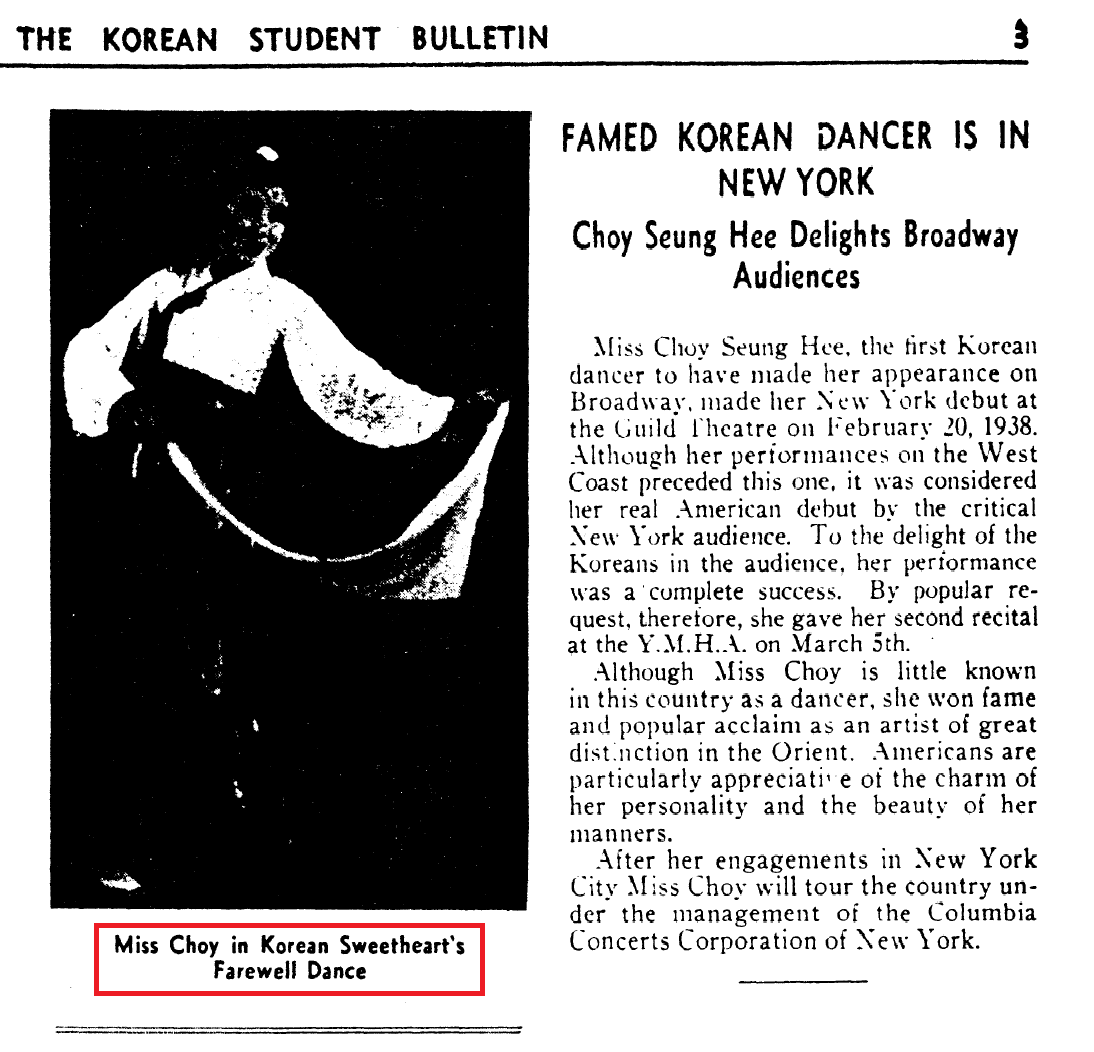
By compiling materials on Choi’s U.S. performances, I was able to confirm that the “Minyo-jo(민요조, Folk Song Style)” in question was “Arirang.” While “Arirang” was sometimes rendered as the proper noun “Arirang” in English translations, it was also occasionally translated as “Korean Sweetheart’s Farewell Dance.” This is because the lyrics of the folk song “Arirang” depict the parting of lovers.
When Korean Sweetheart’s Farewell Dance, as reported in English literature, was cited in Korean newspapers, it was often re-translated as Sangbyeol-gok(상별곡). Considering these circumstances, Minyo-jo(민요조), Arirang(아리랑), Sangbyeol-gok(상별곡), and Korean Sweetheart’s Farewell Dance are all different names for the same piece.
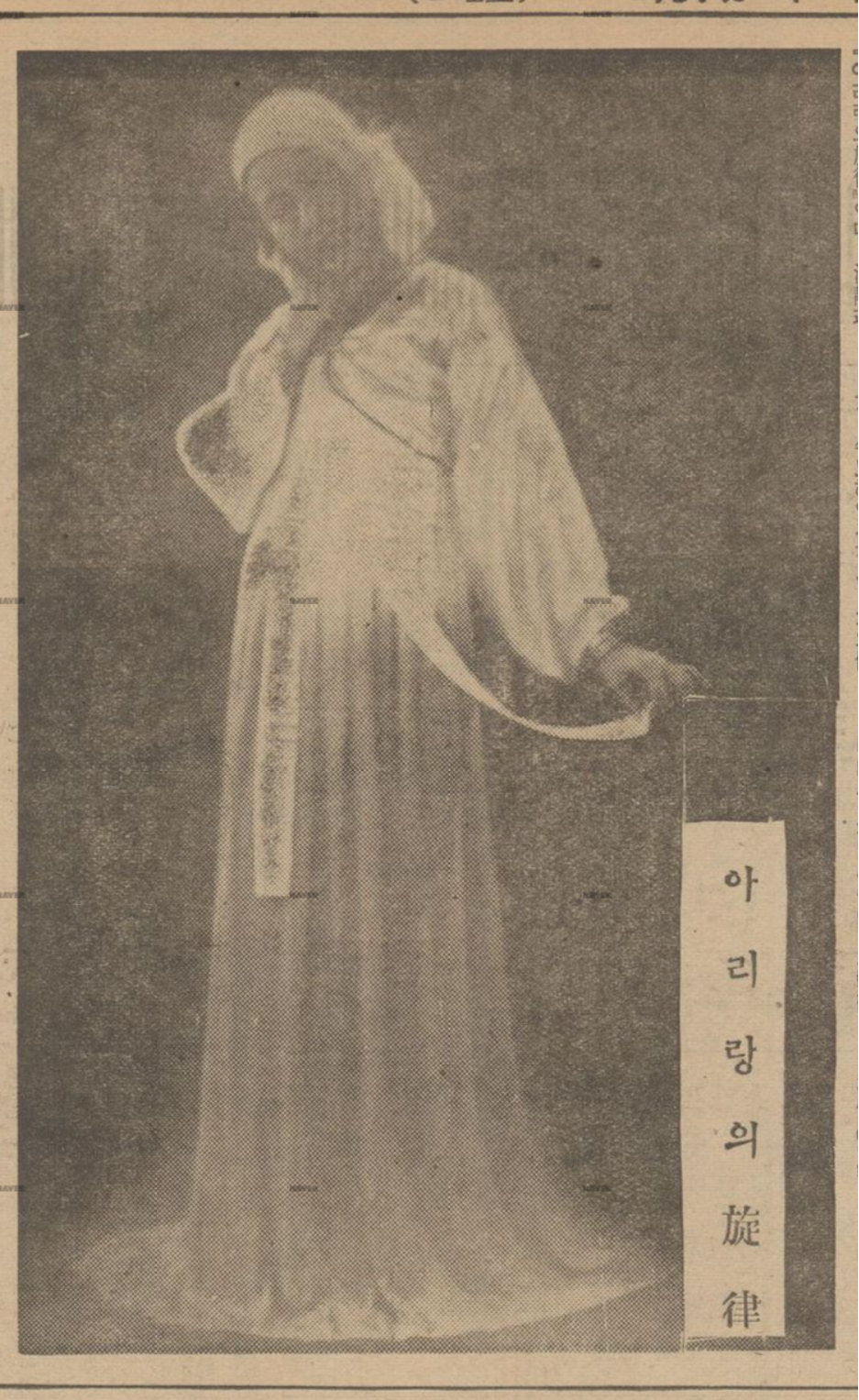
However, the photograph published in the English-language newsletter of Korean students in the U.S. under the title Korean Sweetheart’s Farewell Dance differed from the photographs of Arirang or Minyo-jo found in other sources.
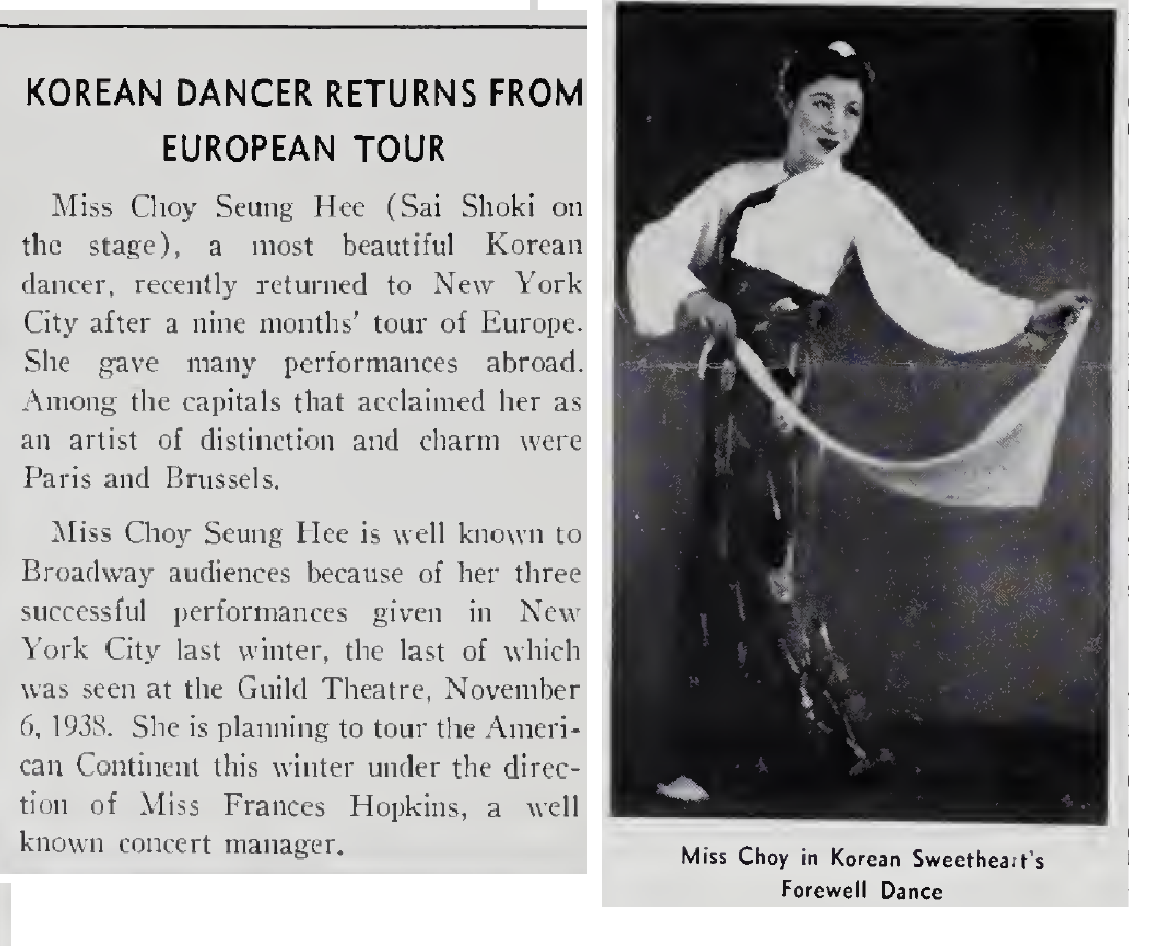
In Minyo-jo, the performers wore simple hanbok and headscarves but held no props in their hands; in contrast, the photograph in the Korean Student Bulletin showed performer in elaborate hanbok, with silver hair ornaments and holding handkerchiefs or wraps. What happened?
The clue to the solution was provided by Sinhanminbo (신한민보, February 10, 1938), a newspaper for Korean American immigrants. Reporting on Choi’s performance in Los Angeles (February 2, Ebell Theatre), the newspaper introduced Arirang as “a dance of parting with a lover,” while describing Gisaeng Dance as “a seductive dance in which the performer, with her hair pinned up and adorned with a silver hairpin, wears a worn jeogori over a long skirt, ties her waist tightly with a sash, and waves a handkerchief while dancing before her lover, melting the hearts of lovesick vagabonds.”
It is precisely this Gisaeng Dance that accurately describes the photograph published in the Korean Student Bulletin. In other words, the caption accompanying the photograph in the newsletter referred to the Gisaeng Dance, not Arirang.
However, the questions do not end there. This is because Gisaeng Dance (Danse de Kiisan in French) was also included in the repertoire of Choi’s Paris performance (January 31, 1938, Théâtre Sal Pleyel), yet the description of this piece differed from that in the Sinhanminbo. The program for the Paris performance described Danse de Kiisan as follows: “A gisaeng wearing a janggu dances and sings, capturing the wandering poet’s attention.”
In other words, while the Gisaeng Dance performed in Los Angeles and New York used a “handkerchief” as a prop, the Gisaeng Dance performed in Paris used a “janggu.” Photographs of the Paris Danse de Kiisan were published in various European newspapers, and based on these photos, artist Bae Un-seong created the print Janggu Dance (1955). This print was exhibited at the Choi Seung-hee Dance Art Exhibition, held to commemorate the 30th anniversary of Choi Seung-hee’s dance career.

However, it is important to note that traditionally Gisaeng Dance and Janggu Dance differed in content and context. Gisaeng Dance was a “dance performed by gisaengs to seduce or entertain guests,” whereas Janggu Dance was a “dance performed to pray for a bountiful harvest or to give thanks for the harvest.”
Choi’s U.S. performance repertoire included a piece translated as Festival Dance or Commemorative Dance alongside Seoul Gisaeng, and it is presumed that a “janggu” was used as a prop in Festival Dance, while a “handkerchief” was used in Seoul Gisaeng.
However, while Festival Dance is not found in Choi’s European performance repertoire, it is noted that in Gisaeng Dance, a “janggu” was used as a prop instead of a “handkerchief.” (jc, 12/16/2025) ⒸCho Jeong-hee
'최승희100장면' 카테고리의 다른 글
| [崔承喜100シーン] 14. エヘヤ・ノアラ (0) | 2026.04.06 |
|---|---|
| [최승희 100장면] 14. 에헤야 노아라 (0) | 2026.04.06 |
| [崔承喜100シーン] 23. 妓生舞 (1) | 2026.04.06 |
| [최승희100장면] 23. 기생춤 (0) | 2026.04.06 |
| [Choi Seung-hee 100 Scenes] 24. Seungmu (승무) (0) | 2026.04.05 |


