Seungmu(1934) is one of Choi Seung-hee’s early works in Chosun Dance (조선무용). Although Yeongsanmu(영산무, 1930) was the first Chosun Dance Choi presented in Gyeongseong(=Seoul), Eheya Noara (에헤야 노아라, 1933) was the first Chosun Dance she performed in Japan, and Geommu(검무, 1934) and Seungmu, presented at the 1st Tokyo Performance in 1934, are also considered early major works by Choi.
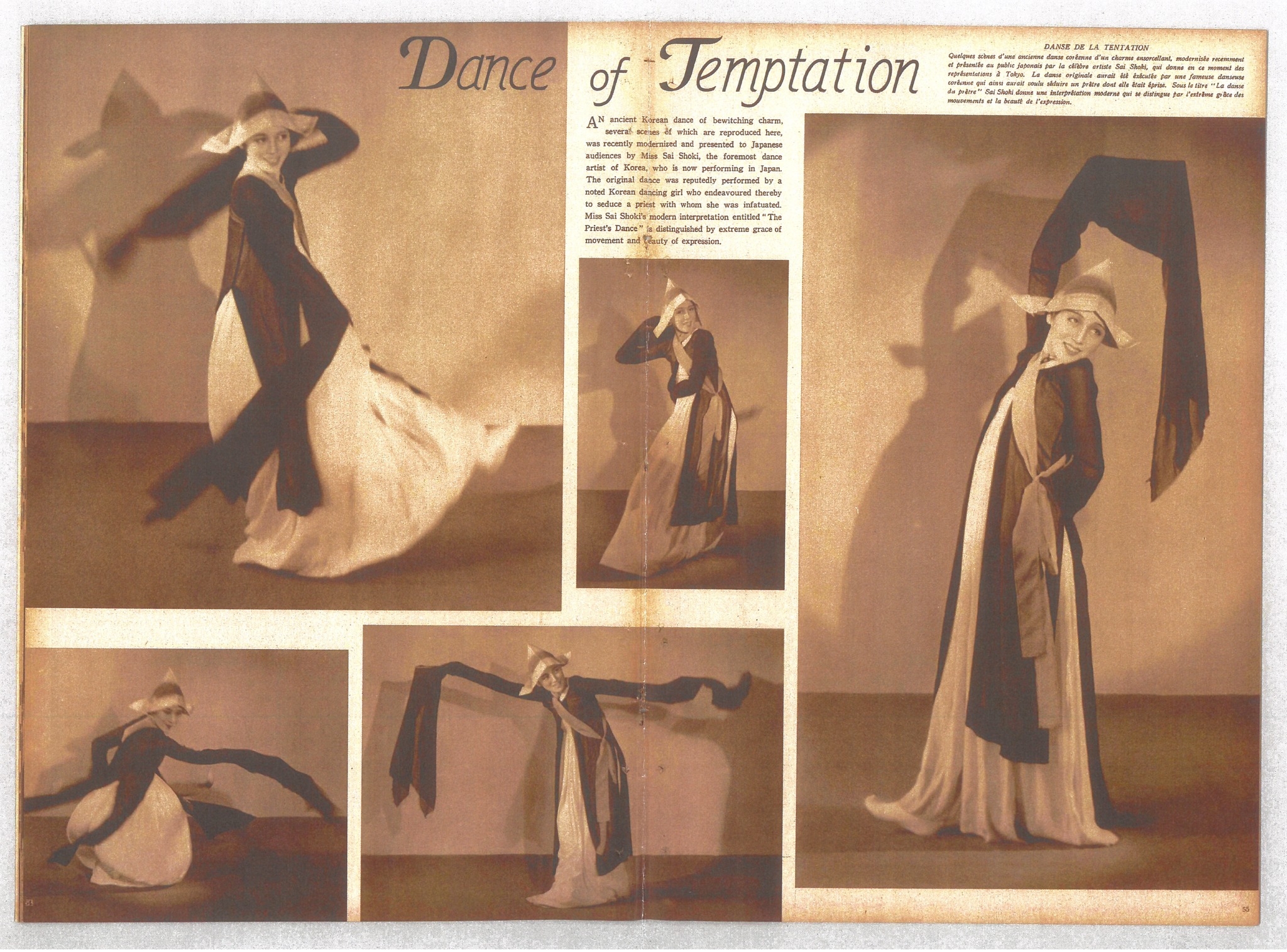
There are many photos of Seungmu preserved to this day. Since the first photograph of Seungmu was published in the Maeil Sinbo (Page 7) on October 21, 1934, various photos of Seungmu have appeared not only in Korean-language newspapers such as Chosun Ilbo and Dong-A Ilbo, but also in Japanese-language newspapers such as the Gyeongseong Ilbo and Chosun Shinmun.

Photographs of Seungmu are also frequently found in Japanese media. They appeared in daily newspapers such as the Asahi(朝日), Nichinichi(日日), and Miyako(都) Shimbun, as well as in monthly and weekly magazines such as Kaikan Geijutsu(会館芸術), Fujokai(婦女界), Fujin Club(婦人俱樂部), and Asahi Graph(朝日グラフ). In addition to Tokyo media, numerous photographs of Seungmu are found in regional newspapers in Hakodate, Asahikawa, Osaka, Kobe, Tokushima, and Uwajima.
The Seungmu photograph, published in the monthly film magazine Eiga Asahi (映畵朝日) on February 1939 issue, was discovered during my research on Choi’s U.S. tour. This photograph was published with an article titled “Choi Seung-hee’s (New York) Concert,” and was taken by the author of the article, “Yasuji Nishiyama (西山保治), a resident of New York.”
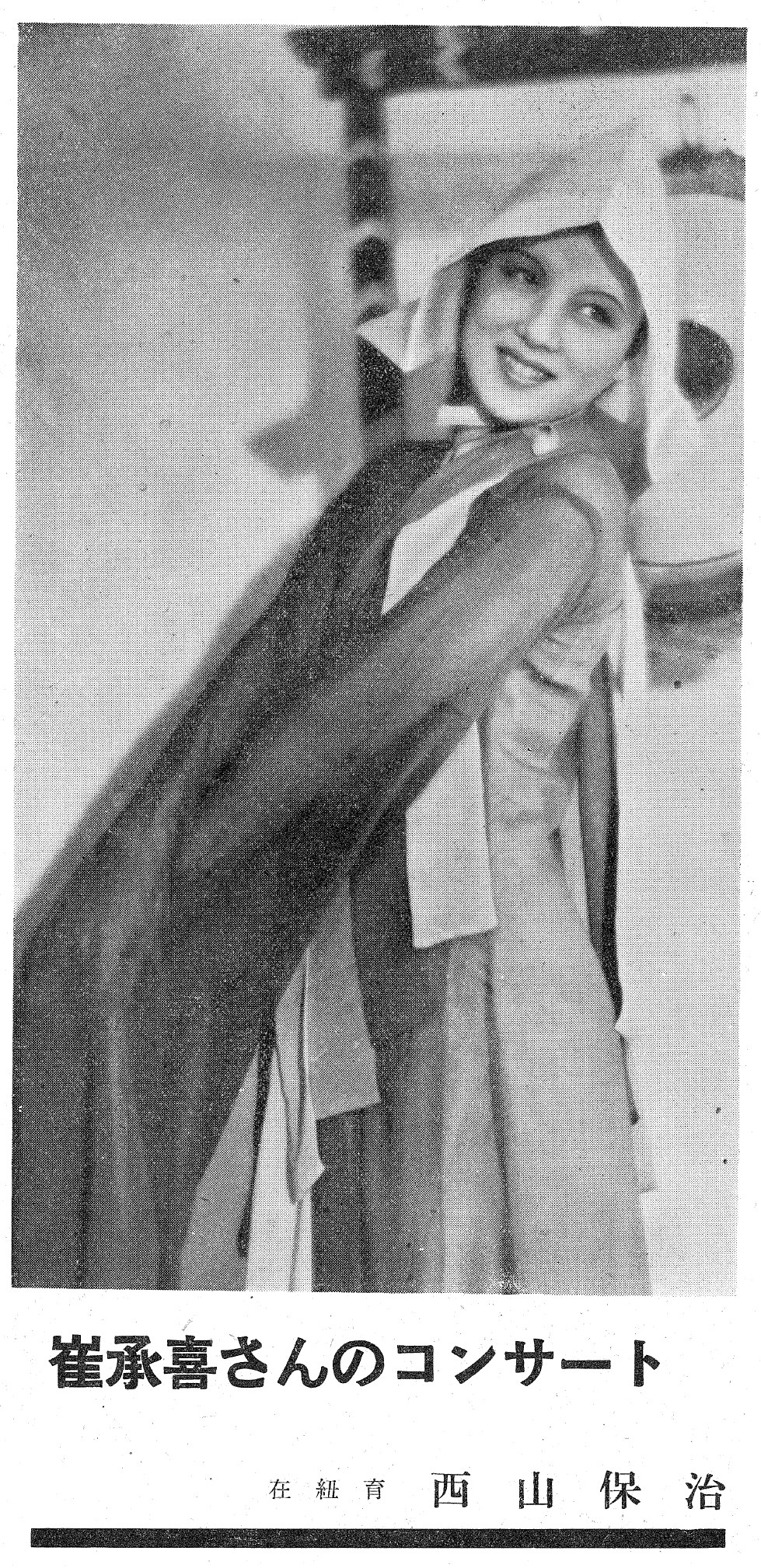
Nishiyama was a photographer and writer who contributed an article titled “The American Photography Scene and the NRA” to the September 1934 issue of Asahi Camera(朝日カメラ), and also published a reportage titled “Visiting New York’s Entertainment District (盛場)” in the July 1, 1940, issue of Kaikan Geijutsu(会館芸術). The Japanese term “sakariba(盛場)” originally referred to an area where brothels or theaters were concentrated, but by the 1930s, it came to denote lively districts with entertainment, shopping, and restaurant facilities.
Nishiyama reported on the local media’s reaction to Choi’s second New York performance on November 6, 1938, stating that while she was a striking beauty, she had not demonstrated the qualities of a great dancer, and advised her to devote herself more to her art. He specifically pointed to the musical accompaniment as a shortcoming of Choi’s performance. He noted that while the accompaniment for her first New York performance was piano and for her second performance was recorded music, it would have been preferable to have Korean musicians perform Korean music live.
Nevertheless, Nishiyama assessed that “Oriental lyricism” and “continental humor” were the major strengths of Choi Seung-hee’s dance. He noted, however, that while “Oriental lyricism” failed to resonate with American spectators who did not understand it, “continental humor” was welcomed not only by Asians but also by Americans; therefore, Choi should continue to develop works in this area with greater strength and depth.
In conclusion, Nishiyama stated that despite his criticisms, he was “a hundred percent an admirer of Choi Seung-hee in every aspect of her character and demeanor” as she was “the only female dancer produced by the East.” adding that he hoped she would “continue to study and achieve further development in the future.”
Appreciating the humorous aspects of Choi’s work, Nishiyama included a photograph of Seungmu—taken by himself—alongside the article. In this photo, Choi Seung-hee humorously depicts a scene in which Hwang Jin-i (황진이), a gisaeng renowned for her literary and artistic talents during the mid-Chosun period, seduces the monk Jijok (지족선사).

Seungmu was also performed as the first piece of Part 1 at the Paris performance on January 31, 1939. The program for the performance translated Seungmu as “The Buddhist Seductress (Séductrice Bouddhiste)” and explained that “disguised as a Buddhist monk, she enters a temple and, dancing to the sound of drums, corrupts the Buddhists.”
The pamphlet also added that it was “a dance evoking the period when Koreans resisted Buddhism, which had grown too powerful,” suggesting that the historical backdrop presented was the mid-Chosun period, when the policy of promoting Confucianism and suppressing Buddhism—which served as the context for this work—was in effect.
In Nishiyama’s photograph of Seungmu, Choi Seung-hee’s gestures and facial expressions vividly capture the charm and playfulness of Hwang Jin-i as she seduces monk master Jijok. (jc, 12/28/2025)
'최승희100장면' 카테고리의 다른 글
| [崔承喜100シーン] 23. 妓生舞 (1) | 2026.04.06 |
|---|---|
| [최승희100장면] 23. 기생춤 (0) | 2026.04.06 |
| [崔承喜100シーン] 24. 僧の舞 (0) | 2026.04.05 |
| [최승희 100장면] 24. 승무 (0) | 2026.04.05 |
| [100 Scenes of Choi Seung-hee] 19. Arirang (0) | 2026.04.03 |


