Among the photographs of Choi Seung-hee’s Chosun Dance (조선무용), there are some where the title of the piece is not specified. A photograph published on page 3 of the Japanese-language edition of the Japanese-American newspaper Shinsekai Asahi Shinbun on December 13, 1937, is one such example.
The caption for this photograph simply reads, “Dancer Choi Seung-hee, who will soon arrive in San Francisco,” without revealing the title of the piece. This photograph also appeared in the English edition of the same newspaper on December 15 (page 7), but the caption for that article merely identified her as “Choi Seung-hee (SAI SHOKI).”

Two methods can be used when researching photographs of Choi’s works: (1) closely examining the photograph to find clues that might suggest the content or title of the piece, and (2) investigating the repertoire of performances held around the time the photograph was published.
Even upon close inspection, it is difficult to find clues in this photograph. First, the costume is unfamiliar. She is wearing a skirt so long that it would be difficult to dance in, has wide sashes tied around her chest and waist, and is holding something resembling towels in both hands.
This costume does not appear to be a typical women’s hanbok. Nor does it look like a Japanese kimono. While the thick sashes around the chest and abdomen resemble those of a women’s kimono, the skirt is too wide. Furthermore, the collar below the neck does not appear Japanese but resembles the Dongjeong collar of a hanbok.
The hat is also unfamiliar. With its wide brim and low crown, this hat looks somewhat like a Chinese-style hat. While it is understandable that the hat strap is tied under the chin to prevent it from slipping off during the performance, the decorative ribbon hanging down long enough to drag on the ground—separate from the hat strap—is neither Korean, Japanese, nor Chinese in style.

However, two clues are worth noting. First, the fabric and style of the clothing appear luxurious. It looks like attire for the upper class or formal wear for a special occasion. Second, there is the veil draped from the back of the hat. Although it is blurry in the photo, this veil also extends past the knees and nearly to the floor. The long veil hanging down the back of the head resembles a decoration seen in Western-style wedding dresses.
Next, I looked into Choi Seung-hee’s concerts immediately before and after this article was published. My goal was to investigate the repertoire presented at each performance. During her “Dogu Farewell Tour” held three months earlier, from September 27 to 29, at the Tokyo Theater, Choi performed 23 works over the course of three days. Given that the title of the performance included the word “Dogu” (渡歐, meaning “departure for Europe”), it is clear that, at that time, the first destination of Choi’s world tour was Europe, not the United States.
Among the 23 pieces in this concert, the works that could potentially be the solo dance by a woman depicted in this photograph are <Dancing Girl(무녀, 舞女)> and <Yeomyangchun (염양춘, 艶陽春)>. The other works either feature male protagonists or, even if they feature female protagonists, are pieces whose titles are already known from other photographs.
Meanwhile, the Japanese edition of the Nichi-Bei Newspaper (Page 3) on January 22, 1938, reported that Choi would perform a piece titled The Bride of Chosun (朝鮮の花嫁) at the Curran Theatre in San Francisco, and the English edition of the California Mainichi Shinbun (Page 5) on February 2, 1938, reported that Choi Seung-hee would present Honeymoon Dance at the Ebell Theatre in Los Angeles.
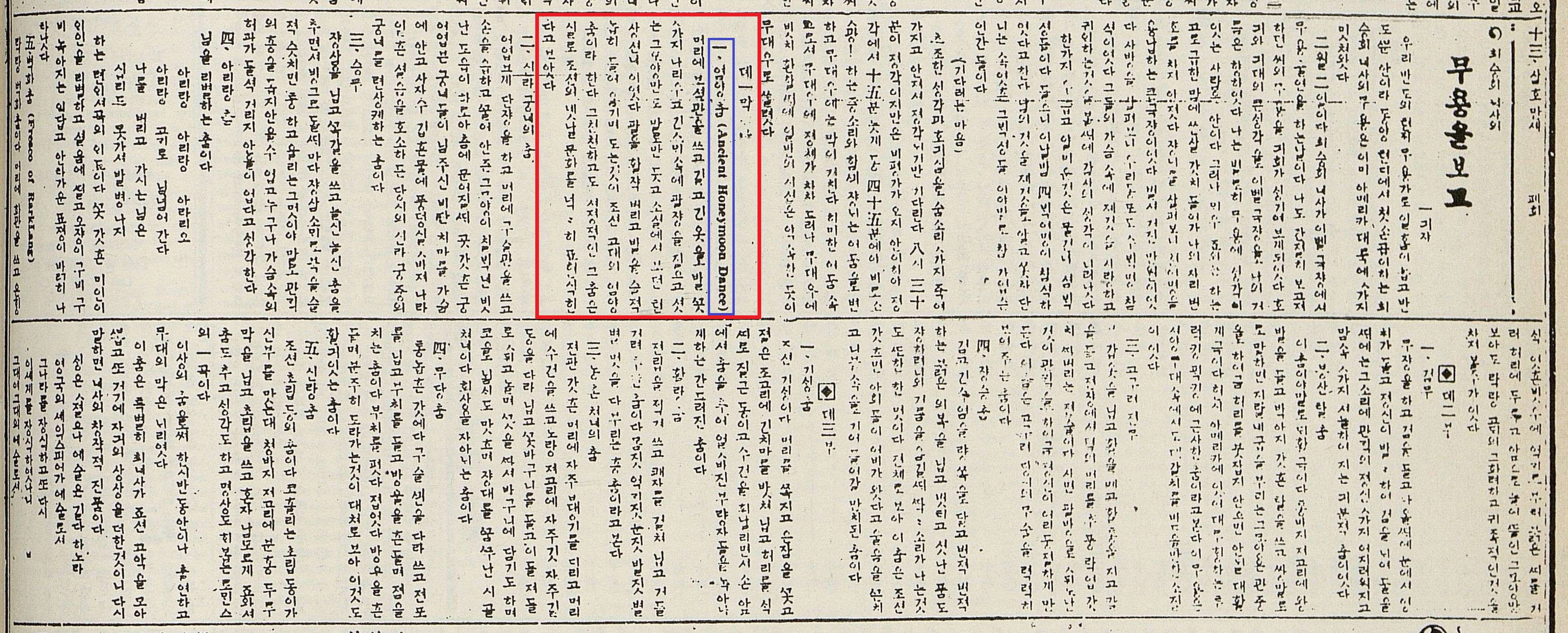
The Bride of Chosun and Honeymoon Dance are likely Japanese and English translations of the same work, as both are dances related to a young woman’s marriage. A review confirming this connection was published in Sinhanminbo(신한민보), a newspaper for Koreans in the U.S. published in Los Angeles. An article titled “After Watching Choi Seung-hee’s Dance” by “A Reporter,” published in the February 10, 1938 (Page 2), provided the following commentary on Yeomyang Dance:
“Act 1, Scene 1: Yeomyang Dance (Ancient Honeymoon Dance). Wearing a bodhisattva crown on her head, with a long, flowing robe reaching down to her toes, and standing with her arms crossed inside her long sleeves—her very appearance alone made her seem like a celestial maiden from legends and novels. It is said that the ancient Yeomyang dance of Chosun involves spinning while spreading one’s arms wide and lifting one’s feet slightly high as one moves. I felt that this slow and lyrical dance truly captured the essence of Chosun’s ancient culture.”
While it is difficult to accept that the headpiece was described as a “Bodhisattva crown,” the references to “long sleeves” and “a long robe flowing down to her toes” accurately depict the woman in the photograph. Furthermore, this commentary added the English title of Yeomyang Dance as “Ancient Honeymoon Dance.”
Therefore, this photograph must undoubtedly be of Yeomyangchun(염양춘) rather than Munyeo (무녀, Dancing Girl), which was performed at the Tokyo Theater a month earlier. Yeomyangchun means “beautiful (yeom) and bright (yang) spring (chun).” It metaphorically refers to the bright and beautiful appearance of young people who have entered the spring of their lives.

The Western term “honeymoon,” which refers to the newlywed period, also derives from the meaning “a month as sweet as honey.” Korea’s “Yeomyangchun” was essentially the same concept as the Western “honeymoon.”
During the Chosun Dynasty, Yeomyangchun was also the title of an instrumental music piece. It was a solo piece for the piri (Korean flute) and was primarily performed at royal banquets. Consequently, it was also known at the time as <Geosangak> (거상악, 擧床樂), meaning “music for serving the table.” Often performed on the sepiri (slender flute) or hyangpiri (fragrant flute), Yeomyangchun features a slow yet free-flowing melody and rhythm, evoking a sense of leisure and elegance.
Choi Seung-hee’s The Bride of Chosun (朝鮮の花嫁, performed in San Francisco) and Honeymoon Dance (performed in Los Angeles) were titles translated from the Korean title Yeomyangchun into Japanese and English.
Furthermore, when Choi Seung-hee performed her own Yeomyangchun, the Honeymoon Dance, she likely arranged the original Korean classical piece Yeomyangchun to serve as the accompanying music, adapting it to fit the length and flow of the dance piece. (jc, 11/27/2025; 3/31/2026) ⓒCho Jeong-hee
'최승희100장면' 카테고리의 다른 글
| [崔承喜100シーン] 19. アリラン (0) | 2026.04.03 |
|---|---|
| [최승희 100장면] 19. 아리랑 (0) | 2026.04.03 |
| [崔承喜100シーン] 8. ヨムヤンチュン(艶陽春) (0) | 2026.04.03 |
| [최승희 100장면] 8. 염양춘(艶陽春) (0) | 2026.04.03 |
| [Choi Seung-hee 100 Scenes] 18. Shaman Dance (무당춤) (0) | 2026.04.02 |


