When announcing her world tour, Choi Seung-hee declared, “I will travel the world wearing traditional Korean attire.” Ten days before her departure, on October 20, 1937, the Dong-A Ilbo published the following article:
“Since the mission of this tour is to introduce our unique art, the costumes were tailored to fit that purpose: adorned with gold hairpins and gold earrings, featuring a kutdong-chogori (a top with decorated cuffs) and a long chima (skirt), and even buseon (Korean socks) and kot-daengi (red, purple, or black cloth or ribbons tied to the ends of braids)—she will set out fully embodying the image of a Korean noblewoman.”

When she departed from Tokyo Station, Choi Seung-hee was wearing a suit and a fur coat, but at the onboard party on the Chichibu Maru, which set sail from Yokohama, she was dressed in traditional Korean attire.
This onboard party was a welcome event for passengers hosted by the captain, and it was a Japanese-style sukiyaki party. All the other members of her party sitting at the table were dressed in suits, and her husband, An Mak, was even wearing a Japanese-style yukata, but Choi Seung-hee alone was in traditional Korean attire—specifically, a white chogori and a dark-colored chima.
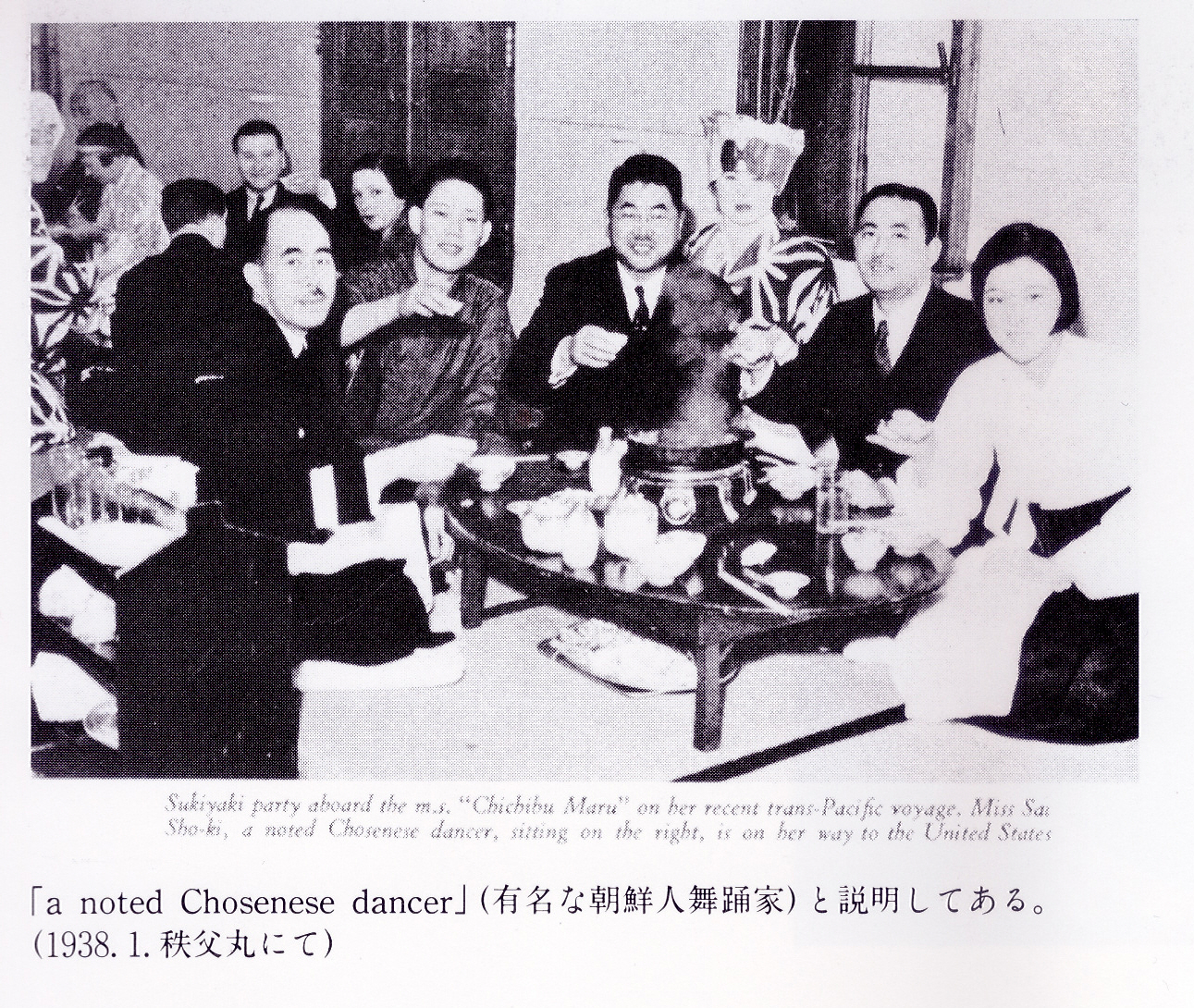
After completing the two-week voyage across the Pacific and arriving at the Port of San Francisco, Choi Seung-hee was wearing traditional Korean attire when she disembarked. Since newspapers only published photos of Choi Seung-hee’s upper body, it is unclear whether she was actually wearing a “long chima,” but her jacket was a colorful, patterned traditional Korean garment.
After completing performances in San Francisco and Los Angeles, Choi Seung-hee arrived at Grand Central Station in New York on a transcontinental train wearing the same outfit she had when she disembarked in San Francisco—that is, a Korean-style jacket with a colorful pattern. The New York media published full-body photos of Choi Seung-hee, showing her wearing a Korean-style “long chima” and “bassen” with “rubber shoes.” However, it is impossible to confirm from the photographs whether this chogori was a “kutdong-chogori.”

Two photographs of Choi Seung-hee taken at New York’s Grand Central Station still remain. One shows her stepping off the train, and the other shows her sitting on her suitcase on the platform after disembarking. These two photographs were taken after Choi Seung-hee posed for a photographer who had come to greet her at the station.
While taking photos while traveling is commonplace today, 90 years ago, both travel and photography were luxuries enjoyed only by the wealthy and famous. At the time, it was fashionable for famous female travelers to sit on their suitcases for photographs.
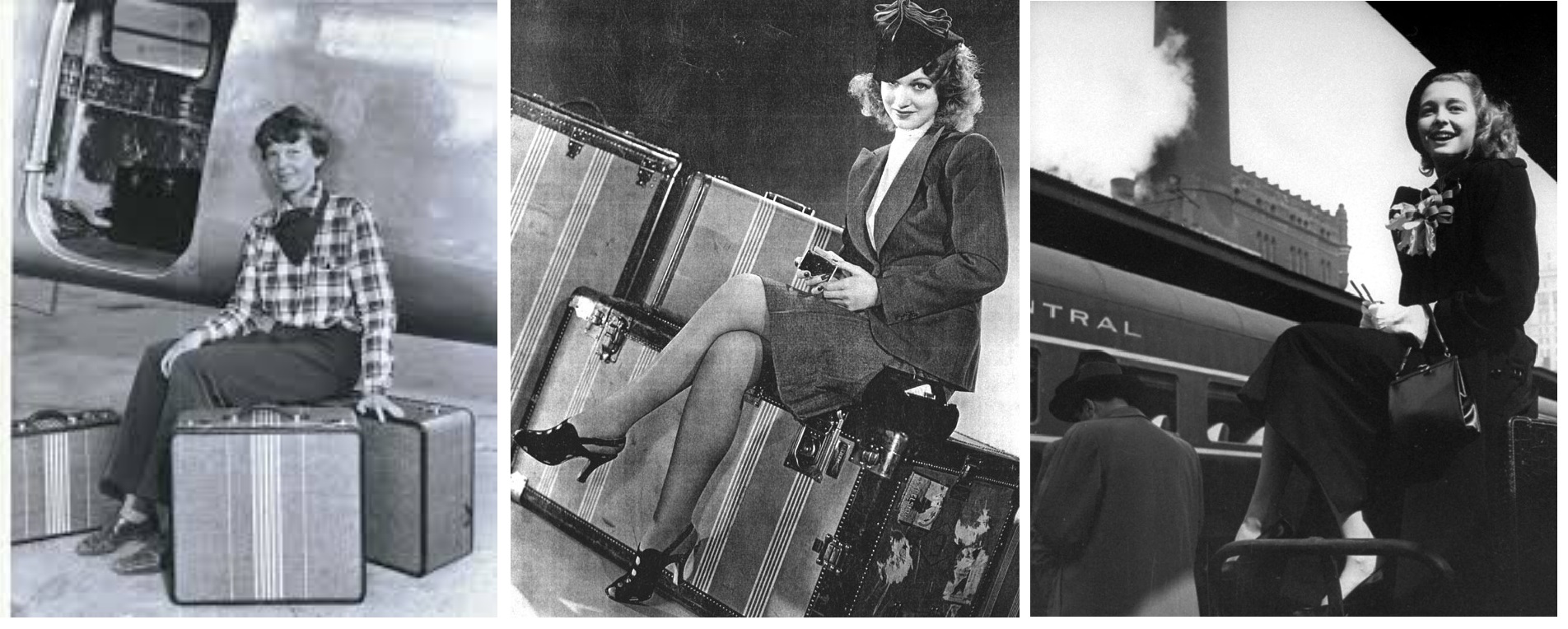
American female pilot Amelia Earhart (1897–1937), actress Carole Landis (1919–1948) and Patricia Neal (1926–2010) left photographs of themselves sitting on their travel bags, and when Choi Seung-hee arrived at Gare du Nord in Paris on December 24, 1938, a photograph of her similar pose was published in several Parisian newspapers.
Since suitcases at the time were large and sturdy, like boxes, it is believed that one could sit on top of them; however, since no photographs have been found of men sitting on suitcases, this must be a pose reserved exclusively for women.
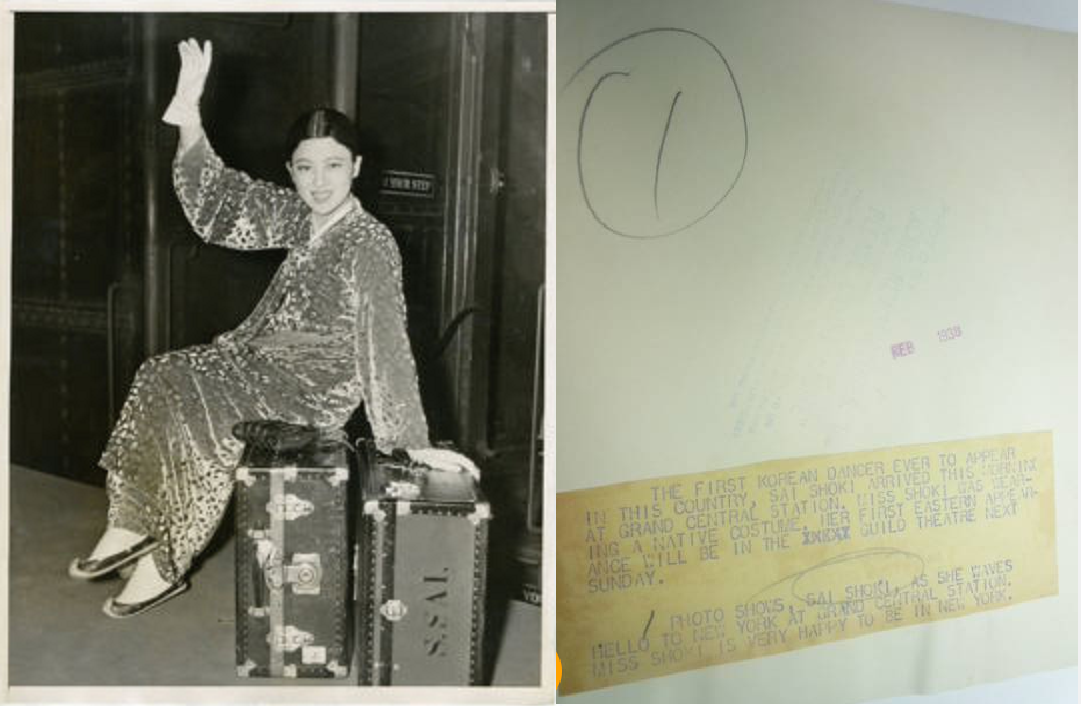
It has been confirmed on numerous occasions that whenever Choi Seung-hee arrived in a new city during her tour of the Americas, she held her first press conference wearing traditional Korean attire. She thus kept her promise to perform her tour in the guise of a “Korean lady.” Why did she do this? The article of the Dong-A Ilbo contains the following passage:
“What is even more significant is that she brought along 30 representative types of ancient Korean musical instruments, as well as bundles of clothing used for weddings, funerals, and other ceremonies, along with interior props such as futons, candlesticks, and writing boxes. She decided to hold exhibitions by renting museums and large halls at each performance venue, and even made donations when requested by cultural organizations, in order to widely introduce Korean culture.”
Choi Seung-hee sought to convey Korea to the Western world not only through Korean dance on stage but also through cultural artifacts and costumes. This is because musical instruments, stationery, and especially clothing served as tools that allowed her to demonstrate her Korean identity, without saying a word about it. (jc, December 10, 2025; March 30, 2026) ⓒCHO Jeong-hee
'최승희100장면' 카테고리의 다른 글
| [崔承喜100シーン] 6. イン·リフア(陰麗華) (0) | 2026.04.01 |
|---|---|
| [최승희 100장면] 6. 인리화(陰麗華) (1) | 2026.04.01 |
| [崔承喜100シーン] 5. ニューヨーク (0) | 2026.03.31 |
| [최승희 100장면] 5. 뉴욕 (0) | 2026.03.31 |
| [Choi Seung-hee 100 Scenes] 4. Los Angeles (0) | 2026.03.31 |


